🔋 Power Banks & Power Outages⚡
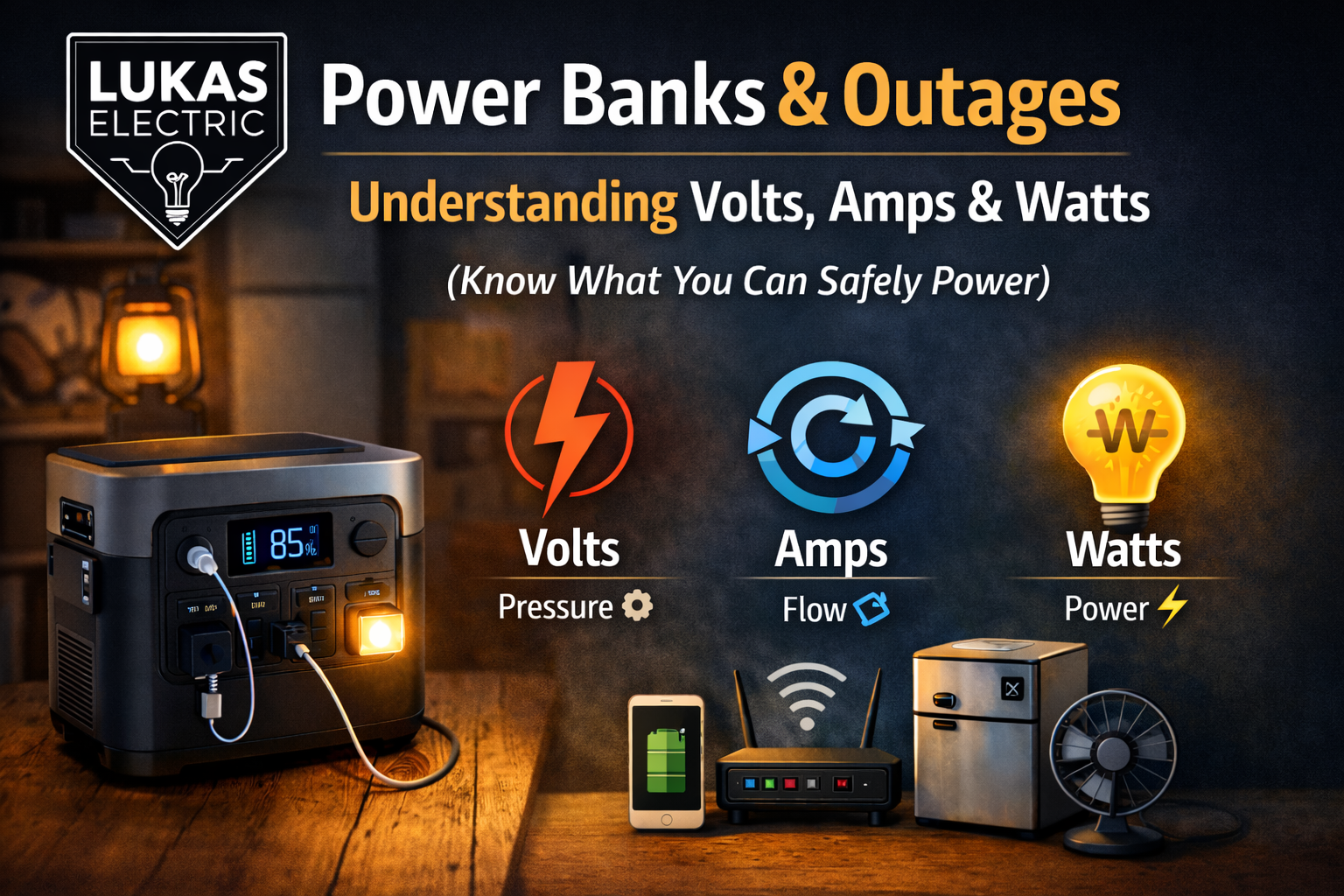
⚡ Understanding Volts, Amps, and Watts (So You Don’t Overload or Damage Anything)
When the power goes out, many homeowners reach for a portable power bank (also called a portable power station) thinking it will keep everything running. Power banks can be incredibly useful during an outage — if you understand their limits.
Most confusion comes down to three words:
Volts, Amps, and Watts ⚡
Once you understand how they work together, it becomes much easier to know:
🔌 What you can safely run
🚫 What you shouldn’t try to run
🤔 Why some devices won’t turn on at all
🔋 What a power bank really is
A power bank is stored electricity inside a battery, paired with an inverter that converts that energy into usable household power.
It is not a generator.
It does not create electricity — it only releases what it already has.
That means every device you plug in is drawing from a limited supply, and the bank has firm limits on how much power it can deliver at one time.
⚡ The three electrical terms that matter
⚙️ Volts (V) – Pressure
Volts describe how hard electricity is being pushed through a wire.
Most household outlets in the U.S. are 120 volts, and many power banks are designed to match that.
Volts tell you the pressure — not how much power is actually being used.
🔄 Amps (A) – Flow
Amps measure how much electricity is flowing.
Small electronics use very little flow.
Larger appliances demand much more.
Higher amps = more strain on the system.
🔥 Watts (W) – The number that really matters
Watts measure total power usage.
This is the number that determines whether your power bank can run a device.
The simple formula to remember:
Watts = Volts × Amps
If your power bank can supply 1,000 watts, and a device needs 1,200 watts, it won’t run — and most power banks will shut off automatically to protect the system.
🚨 Why some devices won’t run (even if the watts look low)
Many appliances have a startup surge, especially anything with a motor or compressor.
For example:
🧊 A refrigerator may run at 150–200 watts
⚠️ But when it starts, it can briefly need 600–1,000+ watts
If the power bank can’t handle that surge, the appliance won’t start — even though it seems like it should.
✅ What power banks are best used for during an outage
🟢 Usually safe and effective:
📱 Phones and tablets
💻 Laptops
💡 LED lamps
📶 Wi-Fi modems and routers
🫁 Medical devices (always check wattage first)
🌬️ Small fans
🟡 Sometimes possible (depends on power bank size):
🧊 Refrigerators or freezers
📺 Small TVs
🔴 Almost never a good idea:
🔥 Space heaters
🍳 Microwaves
☕ Coffee makers
🍞 Toasters
💨 Hair dryers
Anything that creates heat uses a large amount of power very quickly and will overwhelm most portable power banks.
🧠 A simple way to think about it
Power banks are excellent for:
📞 Communication
💡 Lighting
🧊 Food preservation
They are not designed for:
🔥 Heating
🍳 Cooking
⚡ High-draw comfort appliances
If you need warmth, cooking, or whole-home power, that requires:
⛽ A fuel generator
🏠 Or a permanently installed backup system
🎯 Why understanding this matters
Using a power bank incorrectly can:
⚠️ Shut the system down repeatedly
🧯 Damage appliances
🔋 Shorten battery life
❌ Create unsafe situations
Understanding Volts, Amps, and Watts helps you make calm, safe decisions during an outage — instead of guessing under stress.
🧾 The Main takeaway
If you remember just one thing:
⚡ Watts determine what works.
Not the plug. Not the cord. Not the hope.
A power bank is an incredibly useful tool when used correctly — and a frustrating one when misunderstood.
A little knowledge goes a long way toward keeping your home safer, your expectations realistic, and your outage experience far less stressful.
🔧 Thinking Beyond a Power Bank?
Power banks are a great short-term solution — but if you find yourself needing heat, cooking power, or whole-home reliability, it may be time to look at a more permanent setup.
Lukas Electric helps homeowners plan ahead with:
⚡ Generator installations
🧰 Electrical panel upgrades and replacements
🔄 Load evaluations to ensure your system can safely support backup power
🏠 Smart, code-compliant solutions tailored to your home and lifestyle
If you’re not sure what your home can handle — or what it should handle — a quick conversation can save you a lot of guesswork later.
👉 Contact Lukas Electric to talk through generator options or panel upgrades and make sure your home is ready before the next outage.
Email: Contact@lukaselectric.com
Phone: 970-638-8586
